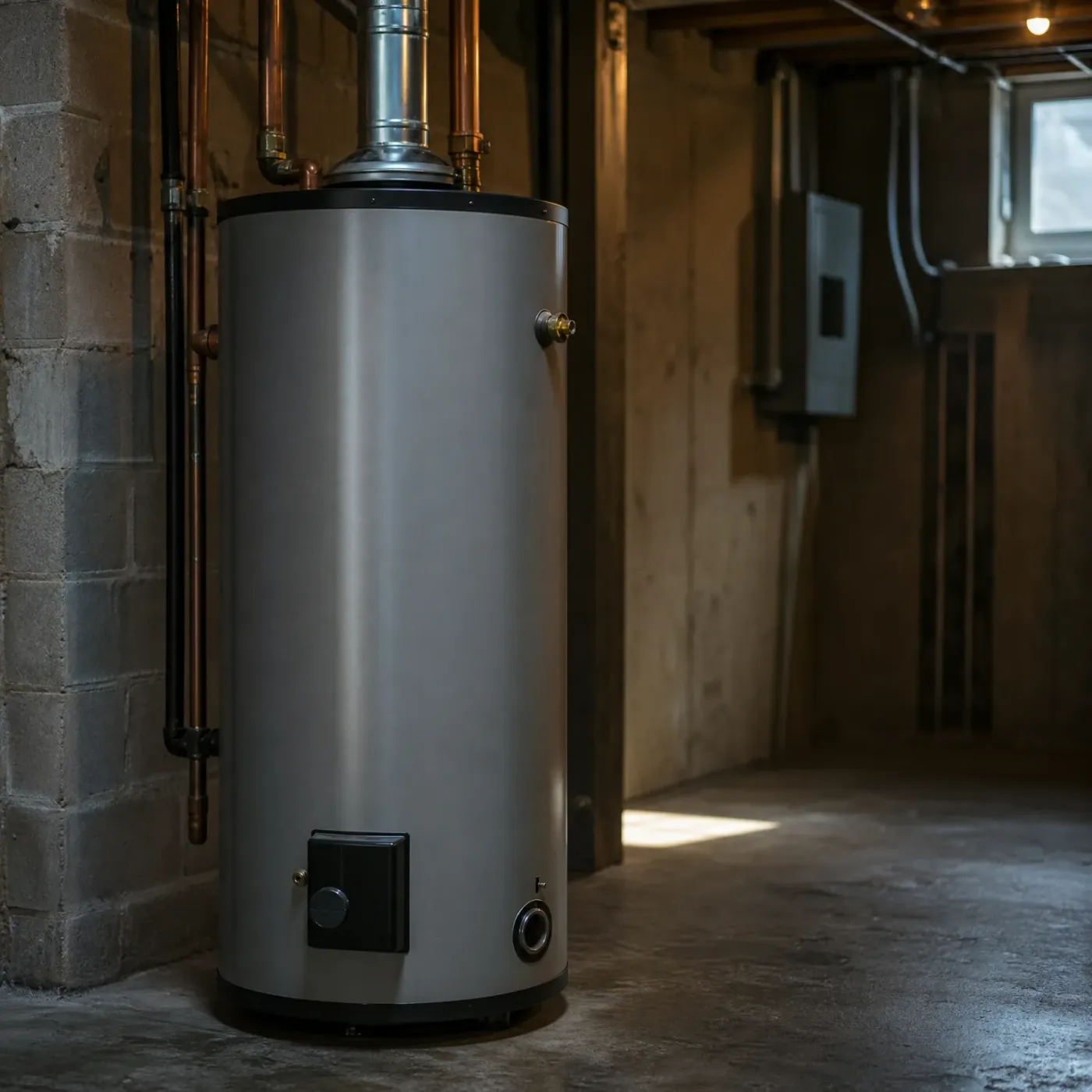




A gray cylindrical gas water heater with a metal flue pipe and copper supply lines stands against a concrete block wall in a dim basement with a concrete floor and a small window.

Get matched with a water heater pro in Reno County

Water heater leaking in Hutchinson, KS

A water heater leaking usually means a tank on its way out, or a loose fitting still worth saving. This page gets into what's dripping where, and what that tells you about which one you're dealing with. Skip calling around Hutchinson and Reno County yourself. Answer a few questions and a contractor who handles this will reach out to you.

Get a water heater pro

A water heater leaking almost always comes from one of a few places. Water on top, around the fittings, usually means a loose connection or a bad inlet or outlet valve, and that's often fixable. Water pooling underneath the tank itself, or rust-colored water coming out, usually means the tank has corroded through from the inside, and once that happens the tank is done. The pressure relief valve can also leak on its own, either because it's worn out or because pressure inside the tank is too high. If your water heater is gas, check around the base for a leak near the burner compartment too, since that's a different problem than a tank failure. How much water you're seeing and exactly where it's coming from tells you whether this is a quick fix or a full replacement, and that's worth sorting out before the leak gets worse or the floor around it takes damage.

A bearded man in a plaid flannel shirt stands indoors looking out a window at snow-covered conifers, with a ceramic mug on the wooden sill and wooden cabinets behind him.
A bearded man in a navy T-shirt sits on a light-colored couch indoors, smiling while looking down at a laptop screen in the foreground, with a framed picture and a potted plant blurred behind him.

Most of what looks like a water heater failure comes down to where the water is actually showing up. The drain valve near the bottom is just threaded into the tank, so if it's weeping, that's a part swap, not a new water heater. The relief valve near the top is built to open when pressure inside gets too high, so water there is telling you something about pressure, not necessarily about the tank. Fittings where the cold water comes in and the hot water goes out can loosen or wear out a seal, and that's usually a quick fix. The one you don't want is water coming from the tank body itself, especially if it's rust-colored. That means the steel has already corroded through, starting as a small crack in the lining inside, and it won't seal back up or get better on its own. During Hutchinson's muggy stretches, check first whether what you're seeing is actually condensation running down the side of the tank rather than a leak at all. Knowing which of these you're looking at tells you whether this is a part or the whole unit.

Where the water is coming from

  • A tank leak starts as a hairline crack in the glass lining, and once water reaches the steel shell it only gets worse.
  • Water at the bottom of the tank can mean the drain valve is loose rather than the tank itself, and that valve can be swapped out.
  • The temperature and pressure relief valve sits near the top and lets go on purpose if pressure inside builds too high, so water from that spot points to the valve or the pressure, not the tank.
  • A leak at the cold water inlet or hot water outlet fitting is usually just a connection that needs tightening or resealing.
  • Rust-colored water dripping from the tank body itself means corrosion has already worked through the steel, and that tank won't hold much longer.
  • Condensation can collect on the tank during humid stretches and run down to the floor, which looks like a leak but isn't one.
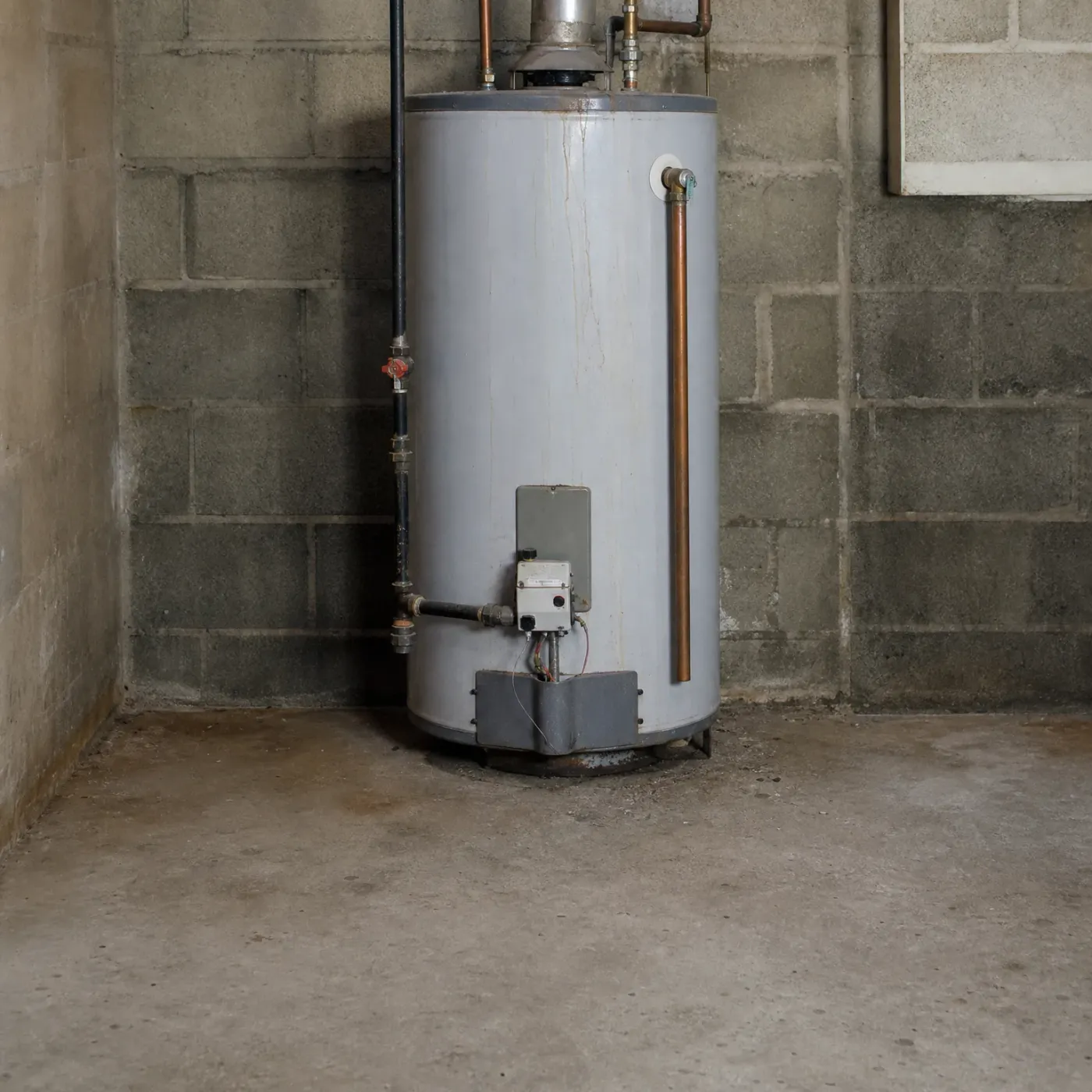
A rusting gas water heater with copper and steel pipes stands against a concrete block wall on a bare concrete floor.
Before you get your water heater repair
A gray cylindrical water heater stands in a basement corner against a concrete wall, with copper pipes, insulated flex lines, a metal flue, and insulated wall framing with ductwork to the right.
After you get your water heater repair

What a leak costs you at home

  • A slow leak behind the water heater can soak the drywall or the floor joists in that closet or utility room before you ever see standing water.
  • If the tank sits on a finished floor, even a small puddle can warp laminate or stain carpet within a day or two.
  • A leak that reaches the gas control valve or the burner compartment on a gas water heater is a reason to shut off the water and the gas to the unit.
  • Reno County's water runs hard, and mineral buildup inside an older tank can hide a crack until it finally works its way through.
  • A water heater that's leaking and still running will keep heating water it's losing, which shows up as a jump on the water bill before the tank fails outright.
  • Letting a small drip go through a Hutchinson winter risks a frozen supply line if the leak is near an unheated wall or crawlspace.

A water heater doesn't leak in a vacuum. It leaks onto something, usually drywall, subfloor, or whatever's stacked in the closet around it, and the longer it runs the more that something matters. If yours sits in a utility closet or a finished room, a slow drip can work into the floor joists or warp the flooring long before you notice a puddle. Carpet and laminate near the tank are especially quick to show damage, sometimes in a day or two.

Gas units raise the stakes a bit. If water is getting into the burner compartment or anywhere near the gas control valve, that's not a wait-and-see situation. Shutting off both the water supply and the gas to the unit is the right call until someone can look at it.

Reno County's hard water adds a wrinkle too. Mineral buildup inside an older tank can mask a crack for a while, holding it together just enough that the leak doesn't show until it's already gotten worse underneath. And a tank that's leaking but still firing will keep heating the water it's losing, so a jump on the water bill can show up before the tank actually quits.

Cold weather brings its own risk. A supply line near an unheated wall or crawlspace, already weakened by a leak, is more exposed to freezing once a Hutchinson winter sets in.

Power here costs 14.49 cents per kilowatt-hour

At 14.49 cents a kilowatt-hour, power here runs close to the national average, so an electric water heater isn't what's driving your bill up. If yours is leaking, that's a tank or fitting problem to deal with on its own terms, not a sign the unit's been working overtime.

EIA-861 2025

Why a tank corrodes from inside

Steel tanks carry a thin glass coating sprayed on inside during manufacturing. That coating keeps the steel away from water. Once it cracks, even at a single spot, the steel underneath starts to rust. Most tanks also have an anode rod built in to attract corrosion before it reaches the lining, but that rod wears down over years of use. When it's gone, the tank corrodes faster. A leak from the tank itself means the lining has already failed somewhere, and there's no way to patch it from outside.


Why fittings fail on their own schedule

The fittings on top of a water heater, the inlet and outlet connections, the pressure relief valve, get loosened by vibration and by years of heating and cooling as the tank cycles. None of that touches the tank's lining. A fitting can work its way loose or wear out its washer while the tank underneath stays sound for years longer. That's why water at the top often has nothing to do with water at the bottom. Each one points to a different part, and a different outcome for the unit as a whole.

A woman in a cream cowl-neck sweater stands in a lamp-lit room looking out a window at a snow-covered yard with shrubs and bare trees at dusk.
A woman in a gray turtleneck sweater stands near a large window in a lamp-lit living room, looking out at falling snow and snow-covered conifers.
A woman in a chunky knit sweater stands by a large window looking out at snow-covered ground, with a dimly lit living room containing a gray sofa, framed artwork, shelves and table lamps behind her.
A woman in a gray turtleneck sweater stands in a dimly lit living room with a lamp and bookshelves, looking out a multi-pane window at falling snow.

Get the right pro for your water heater

Explain the water heater problem once instead of to every shop in Reno County.

There's no charge for the request.

A dim bathroom corner with a glass-enclosed tiled shower containing a rain showerhead and wall niche, a gray towel on a rail beside a bright window, and a large plain wall in shadow at left.

You've got work in forty minutes. You go in to shower and the water never turns warm, just lukewarm at best, no steam coming up over the curtain rod. The towel's still hanging there on the rail where you left it, dry, waiting. You check the handle again like that'll change anything. Down in the utility closet the tank's wet around the base, a dark ring spreading out onto the concrete. It's been fine for years. This morning it isn't, and now you're standing in a cold bathroom in Reno County figuring out what you're going to tell your boss about why you're running late.

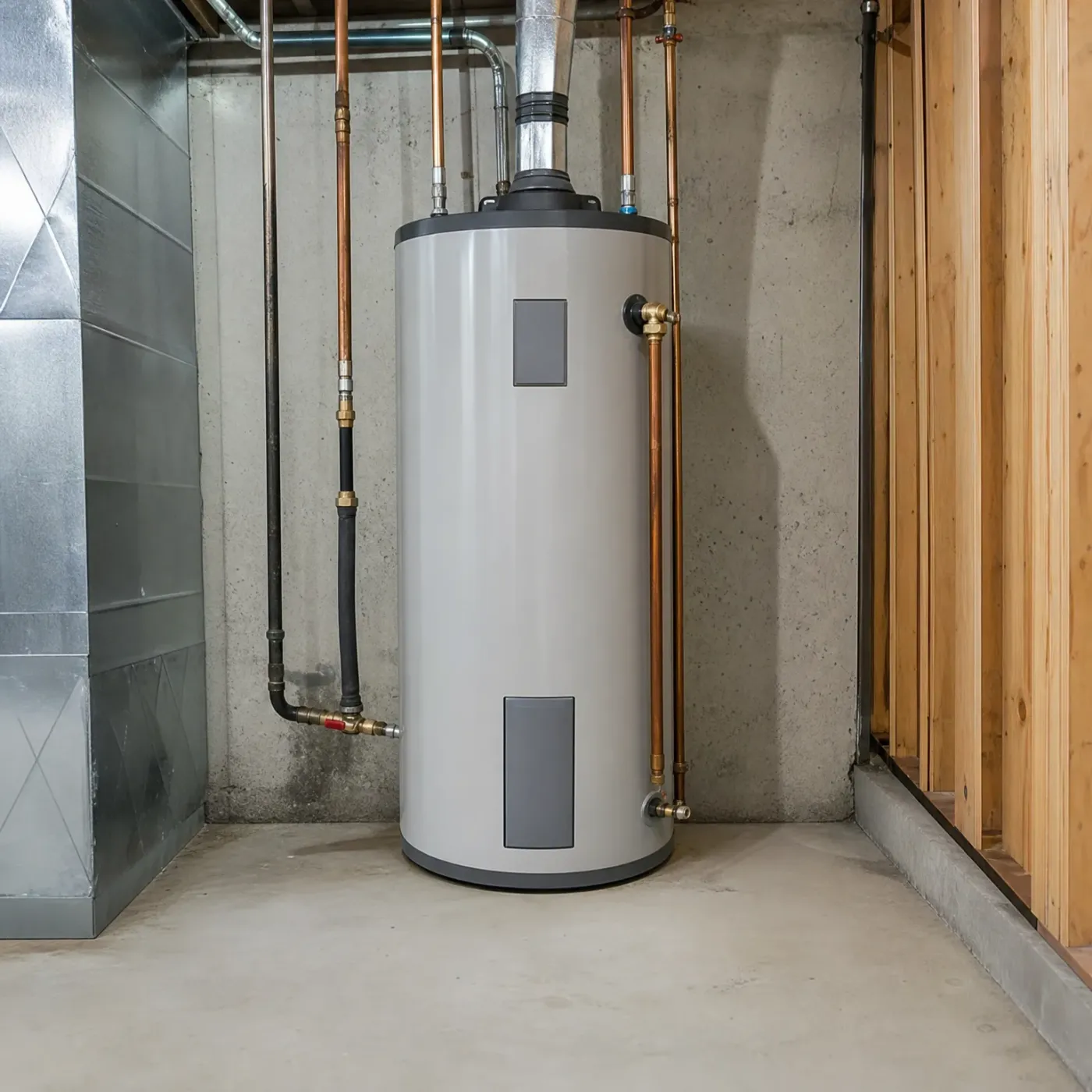
A gray cylindrical water heater standing in a basement corner against a concrete wall, with copper and black pipes, a metal flue, and ductwork nearby, next to wood framing on the right.
A water heater working like this holds steady: no drip at the fittings, no puddle on the concrete, pipes dry where they meet the tank.
A gray cylindrical gas water heater with copper and black pipes stands in the corner of a basement with concrete block walls and a bare concrete floor.
Rust-colored water pooling under the tank, or a steady drip near the gas valve, means something's already failed, not something about to.

Why is water dripping from the bottom of my gas water heater?

Why is water dripping from the bottom of my gas water heater?

It's either the drain valve or the tank itself, and you can usually tell which

Dry off the bottom of the tank and the valve, then check back in an hour. If the drip comes from the drain valve, a plastic fitting near the bottom edge, it's loose or worn and a contractor can swap it out. If water is coming from underneath the tank itself, with no clear source, that's the glass lining cracked inside and the steel rusting through. A gas water heater won't fix that leak, because the tank is sealed shut, no access panel to get inside. Once the shell itself is wet, the tank is done and the only real fix is replacing it before the leak gets worse or the gas valve underneath corrodes too.

  1. A hairline crack forms in the tank's glass lining first.

  2. Steel underneath the crack starts to rust once exposed.

  3. Rust eats through the steel until it pits all the way through.

  4. Water seeps out through that pit, slow at first.

How many people and how old is the plumbing you're dealing with?

  • 2.27 people per household on average

    Reno County households average 2.27 people, so most water heaters here are sized for two or three, not a crowd pulling hot water at once.

  • Half the homes here were built by 1962

    Half the homes in Reno County were built in 1962 or earlier, old enough that the water heater and the pipes feeding it may not be original to the house.

  • 65.1% of homes heat with gas

    Gas heats 65.1% of homes here, and a gas tank leaking near the burner or gas valve needs a faster look than one sitting quiet on top.

ACS 2020-2024

A woman stands in the open front doorway of a single-story house with stone and wood siding while a man in a dark polo shirt and cap walks toward it along a concrete path.

So that's what you're looking at

A water heater leaking comes down to a short list of causes, and checking where the water shows up tells you which one you've got. Water at the fittings on top is often a loose connection worth saving. Water under the tank, especially with rust in it, means the tank itself has failed and repair won't change that.

Either way you've got a decision to make about your water heater, and you don't have to make it by calling around Hutchinson and Reno County to find someone who can look at it. Submitting your information here matches you with a contractor who takes on jobs like yours, and that contractor is the one who calls you back, not the other way around.

Interior corner with sheer white curtains at a window, a brown upholstered sofa in the foreground, and a wooden multi-drawer cabinet holding a round ceramic vase with leafy branches.
A single-story house with horizontal siding and large windows lit from within at dusk, beside a lawn, low path lights and a dark gravel driveway, with pine trees and a distant waterway under an orange and blue sky.

Water Heater Repair

A pro who works on water heaters

Step 1 of 3: Equipment
  • A gray upholstered sofa arm with a cream knit fringed throw sits beside a wooden side table holding a stack of books, a shallow wooden bowl, and a ceramic vase of leafy branches, on a wood floor near a window.
    • Get matched with a pro who works on water heaters in Reno County.
    • Your request goes to a Reno County pro who takes water heater jobs.
  • A living room corner with a cream upholstered sofa and cushion beside a wooden side table holding a ceramic vase of olive branches and a small dark bowl, with a framed landscape painting on the gray wall and a linen curtain at the window.
    • Send the request today and let a water heater pro reach out to you.
    • Get the water heater repair search off your mind today.
  • A wood-framed armchair with a beige cushion and knitted throw sits beside a round wooden side table holding a ceramic mug, with a potted green plant near a window in the corner and a framed picture on the wall.
    • Explain the job once and skip repeating it on every call.
    • Skip searching for a water heater pro and answer a few questions instead.
  • Interior corner with beadboard wainscoting, a gray cabinet with wood countertop holding a vase of greenery below a window, and a potted leafy plant in a woven basket on a wood floor with a fringed jute rug.
    • A licensed pro who repairs water heaters in Reno County gets your request.
    • A licensed pro who works in Reno County gets your request.