Tell us about the job
Takes about a minute. No obligation.
Gas water heaters that go years without a burner or flue inspection accumulate deposits and small draft problems that only show up as a failure. Utility gas heats more occupied homes in Grant County, Kansas than any other fuel, at 67.7% (2020-2024 ACS 5-year). A contractor repairing a unit here works through the combustion side first: the burner orifice, the thermocouple or thermopile, and the flue connection, because those are the components that carry the load in a gas-fired system. Sediment in the tank matters too, but a venting fault is what sends a homeowner back to the phone sooner.
A water heater sitting in a home from this era of Grant County's housing stock was likely fitted with components sized for standards that have since shifted. Half the homes in Grant County, Kansas were built in 1974 or earlier (2020-2024 ACS 5-year). When a contractor opens a unit in stock like this, the question that decides the repair scope is whether the parts it requires are still being made. If they are not, a repair that looks straightforward on the outside becomes a sourcing problem, and the bill changes accordingly. That is what the age of the housing puts in front of the work.
The Parts of a Water Heater a Contractor Checks During a Repair
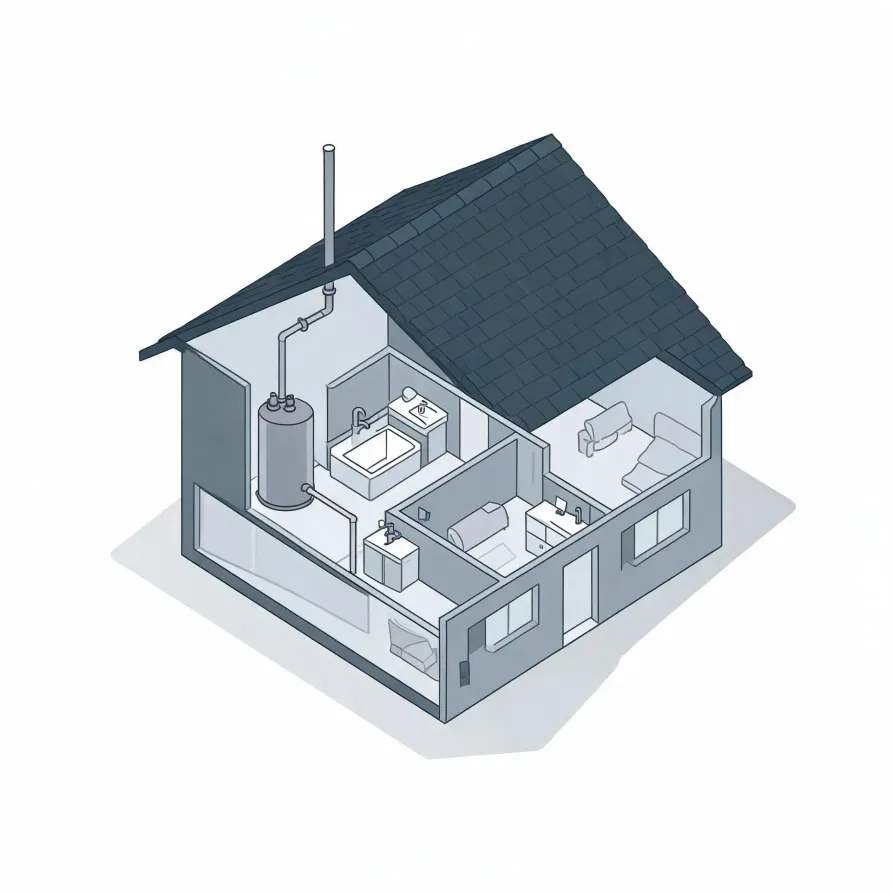
The tank is the piece a homeowner knows best, a large insulated vessel that sits in a utility room, basement, or garage and holds water at a set temperature. Attached to it is the heating element or burner assembly, which does the actual heating work. When a repair call comes in, those two pieces are where a contractor looks first.
The thermostat and pressure relief valve mount directly on or near the tank. The thermostat reads water temperature and signals the heating source to cycle on or off. The pressure relief valve is a safety device that opens if pressure or temperature climbs too high. The supply and return lines connect the tank to the rest of the house's plumbing.
The drawing shows a general layout of these components, and a licensed contractor determines what applies to the specific unit and setup in your home.
Find a contractor in Grant CountyGrant County, Kansas, by the numbers
149 severe weather events were recorded in Grant County, Kansas between 2015 and 2024.
NOAA National Centers for Environmental Information, Storm Events Database, bulk CSV export, events 2015-01-01 through 2024-12-31.Half the homes in Grant County, Kansas were built in 1974 or earlier (2020-2024 ACS 5-year).
U.S. Census Bureau, 2020-2024 American Community Survey 5-Year EstimatesGrant County, Kansas holds 2,933 housing units (2020-2024 ACS 5-year).
U.S. Census Bureau, 2020-2024 American Community Survey 5-Year EstimatesOwners occupy 76.7% of the occupied homes in Grant County, Kansas (2020-2024 ACS 5-year).
U.S. Census Bureau, 2020-2024 American Community Survey 5-Year EstimatesSevere Weather Events in Grant County
Extreme weather puts real stress on water heaters, forcing them to work harder and recover faster than conditions in milder climates require. How much of that load your equipment carries depends on what the weather in this area actually does.
149 severe weather events, 2015–2024. Source: NOAA National Centers for Environmental Information, Storm Events Database.